Electricity has quietly become one of the most important line items on a manufacturer's P&L, and it is no longer a fixed cost you can plan around. U.S. industrial electricity prices rose 8.6% year-over-year in the first quarter of 2026, and in the PJM interconnection region -- which covers big manufacturing states like Ohio, Pennsylvania, and Michigan -- the wholesale capacity price that flows into industrial rates jumped from $28.92 per megawatt-day in the 2024 auction to $329.17 per megawatt-day for the 2026-27 delivery year. That is a 1,038% increase in two years, and the FERC price cap is the only reason it did not go higher.
For factory owners who typically run on 5 to 15 percent operating margins, this is not a rounding error. It is a strategic issue that is quietly reshaping which facilities get built, which get expanded, and which start to look at generating their own power onsite.
The Numbers Behind the Squeeze
The five-year picture is stark. Industrial electricity prices climbed from 6.67 cents per kilowatt-hour in 2020 to 8.62 cents per kilowatt-hour by mid-2026 -- a 29 percent increase. FRED data on average industrial electricity costs shows a 41 percent jump from January 2021 to January 2026. The EIA's Short-Term Energy Outlook expects the industrial average to sit around 8.54 cents per kilowatt-hour in 2026, with additional increases baked into its outlook through 2027.
The regional dispersion is what really matters, though. As of December 2025, average industrial electricity prices were up 31 percent year-over-year in Pennsylvania and 26 percent in Ohio, compared to a 7 percent rise nationwide for industrial customers. Duke Energy pushed through a 14 percent phased rate increase on Indiana businesses in 2025 and 2026, and industrial utilities in Illinois, Iowa, and Missouri have filed for increases as high as 50 percent. Meanwhile, EIA forecasts industrial power sales at 1,053 billion kilowatt-hours in 2026 -- record territory driven by new semiconductor and battery manufacturing capacity coming online alongside data center growth.
For an energy-intensive manufacturer where electricity is 15 to 25 percent of operating costs, a 6 to 7 percent annual rate increase with zero change in output is often the difference between a profitable year and a break-even one. In chemicals, primary metals, and glass -- where energy can be 35 percent or more of the cost base -- the effect is larger and shows up in every quarterly earnings call.
PJM's capacity auction cleared at $329.17 per megawatt-day for the 2026-27 delivery year -- up 1,038% from $28.92 two years earlier. Without the FERC price cap, prices could have reached nearly $389 per megawatt-day.
Why Prices Are Moving
Three forces are converging, and none of them are cyclical.
The first is data center demand. Data center electricity consumption in the U.S. surged again in 2025, and the IEA now projects that global data center electricity demand will more than double by 2030 to roughly 945 terawatt-hours -- more than the current electricity consumption of Japan. In the PJM region specifically, capacity prices exploded because a wave of data center connection requests hit at the same time that older coal and gas generation was retiring. Manufacturers and residential customers on the same regional grid are effectively subsidizing the buildout of hyperscaler capacity.
The second is grid interconnection lag. Utility timelines to energize large new industrial loads now stretch multiple years in many regions. A new plant that can be constructed in 18 to 24 months may then wait another two to four years to be energized. Every month of that delay is deferred revenue, deferred payback on the capital investment, and continued rent, staffing, and financing costs on an idle facility.
The third is generation replacement. Coal retirements have outpaced replacement generation in several regions, and new gas-fired capacity is bottlenecked by turbine order backlogs that now stretch three to five years. Renewable projects that would normally fill the gap are themselves stuck in the interconnection queue. The result is a supply-demand imbalance that shows up first in capacity auctions and then in retail industrial rates.
Why Manufacturers Are Building Their Own Power
The response from large industrial users is becoming pretty consistent: if the grid is going to be expensive and slow, build your own.
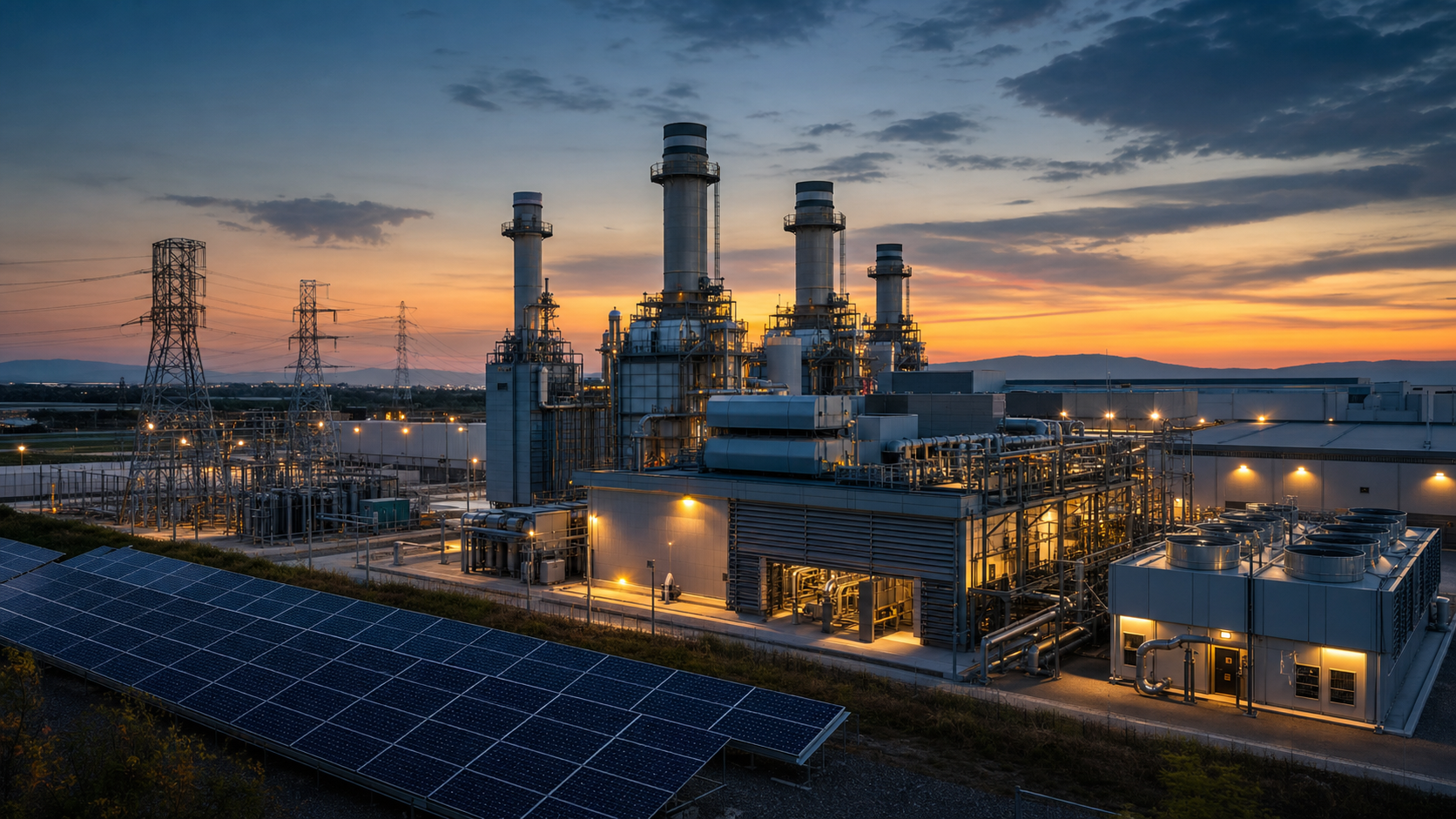
Enverus Intelligence Research is forecasting that 25.5 gigawatts of new U.S. industrial facility demand will be served by behind-the-meter generation between 2026 and 2030. Behind-the-meter, or BTM, means the power plant sits on the same private site as the load and never crosses the utility interconnection point. That does three things at once: it eliminates the multi-year interconnection wait, it decouples the facility from regional capacity price volatility, and it can meaningfully cut the delivered cost of electricity because the manufacturer is paying its own generation cost rather than the utility's cost plus transmission plus distribution plus capacity.
What used to be a fringe strategy is becoming mainstream. Reciprocating gas engines, aeroderivative turbines, on-site solar with battery storage, and increasingly small modular reactor announcements are all showing up in industrial site selection decisions. In one case study reported in 2026, a lithium-ion battery energy storage system deployment on an industrial site was projected to deliver roughly 50 percent in annual electricity cost savings by shifting demand off peak-price windows and providing resilience against grid volatility.
The cost math is not universal. Behind-the-meter economics work best when a facility has a high load factor, is in a region with expensive utility power and cheap natural gas, and has the land and permitting flexibility to host generation on-site. But the number of manufacturers running that math has increased sharply, and the ones building new capacity are increasingly designing the power plant into the site plan from day one rather than treating it as an afterthought.
What This Means for Operators
The manufacturers I talk to are having a version of this conversation whether they realize it or not. Even if you are not ready to build your own generation, the power cost trend is a real input to a set of decisions that used to be routine.
- Site selection now has to weigh grid interconnection timelines and utility rate trajectories alongside labor, tax incentives, and logistics. A location that used to look attractive on a 10-year total cost model can look very different once you rebuild the electricity assumption with 2025-2026 actuals.
- Capacity expansion decisions need to include a "what does it cost to energize" analysis, not just a "what does it cost to build" analysis. In regions with multi-year interconnection queues, that gap can be the deciding factor.
- Contract structures matter more. Long-term power purchase agreements, capacity hedges, demand response programs, and time-of-use tariff optimization are all worth revisiting. The rate schedule you signed in 2020 was priced for a very different grid.
- Resilience and generation redundancy are becoming margin protection tools, not just uptime insurance. A day of unplanned outage during a peak-price window costs more than it did five years ago.
The manufacturers who will be best positioned over the next decade are the ones treating electricity strategy as a boardroom conversation, not a facilities-management line item. The gap between the operators who plan around this and the ones who absorb the cost passively is going to widen -- and it will show up in gross margins, in competitive position, and in enterprise value.
Rethinking Your Facility Strategy?
I work with manufacturers navigating the operational and risk implications of new facility construction, expansion, and on-site generation projects. If you are weighing behind-the-meter power, resilience upgrades, or new site development, I'd welcome the conversation.
Get in Touch