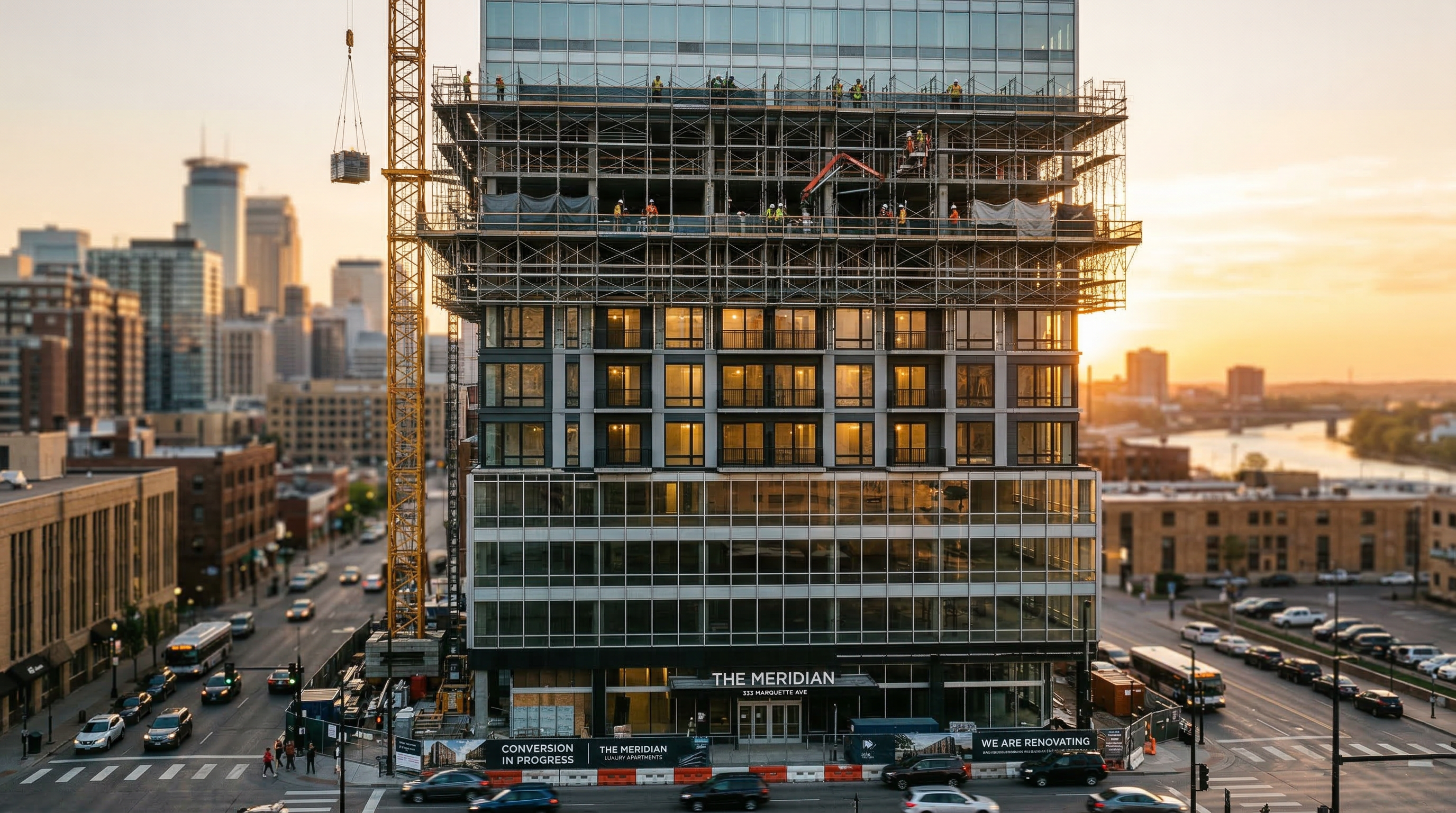
There is no longer any debate about whether office-to-residential conversions are a real trend. They are the defining story in commercial real estate right now. In 2024, nearly 25,000 apartments were completed from adaptive reuse projects across the country -- a 50 percent jump over 2023 and double the total from 2022. The pipeline is even more telling: roughly 181,000 apartments are now in various stages of redevelopment, with office conversions alone accounting for 42 percent of that total. I am watching this movement closely because it sits squarely at the intersection of real estate and construction -- my two largest specialties -- and the risk profile of these projects is unlike anything else in the market.
Why the Conversion Wave Is Accelerating
The math has finally tipped in favor of conversion. Office vacancy nationwide hovers near 18 to 19 percent, with Manhattan sitting at 22.3 percent -- more than double its pre-pandemic average. Office sale prices in Manhattan have fallen 45 percent from their 2019 peak, narrowing the gap between acquisition cost and development site value to the point where converting an office building into apartments pencils out for the first time in many markets.
Policy is accelerating the trend. New York City's Office Conversion Accelerator Program, the 467-m tax incentive offering up to 35 years of tax relief for projects with affordable housing, and the City of Yes zoning reforms have collectively removed barriers that kept conversions theoretical for years. Chicago's LaSalle Corridor incentive program is targeting 1,000 mixed-income apartments in the Loop. Denver launched an Adaptive Reuse Pilot Program with state tax credits taking effect this year. Washington, D.C., offers 20-year tax abatements for commercial-to-residential conversions. Minneapolis has eliminated public hearing requirements. San Francisco updated building codes and created a dedicated financing district.
The result is record-setting activity. In New York alone, conversion starts jumped from 1.6 million square feet in 2023 to 3.3 million in 2024, and had already surpassed 4.1 million square feet through August 2025 -- blowing past the prior full year in just eight months. Another 8.8 million square feet of projects are currently proposed.
More than 1.2 billion square feet of U.S. office space -- 14.8 percent of total inventory -- is considered suitable for residential conversion. Office-to-apartment projects now represent 42 percent of all adaptive reuse in the pipeline.
What Makes These Projects Unique
These are not simple renovations. Converting an office building into apartments requires fundamental structural and mechanical intervention. Developers are cutting light wells into floor plates, carving notches through building cores, rerouting HVAC and plumbing to serve individual residential units instead of open floor plans, and in some cases adding entirely new floors on top of existing structures. Pearl House at 160 Water Street in Manhattan -- a 1970s office tower converted into 588 apartments -- added five new floors during the process.
Interestingly, the profile of buildings being converted is shifting. Class A office buildings now account for more than a third of post-2020 conversions and represent a majority of future proposals at 52 percent. This is a change from the earlier wave, when conversions focused almost exclusively on outdated Class B and C properties. Newer, higher-quality buildings offer modern infrastructure and premium locations that translate well into luxury apartment projects, which is where the strongest investor appetite sits right now.
The geographic spread is also widening. While New York and Washington, D.C., continue to lead, Charlotte doubled its conversion pipeline last year. Boston's pipeline grew 160 percent. Jacksonville saw a 150 percent increase. Office conversions now account for more than 50 percent of all adaptive reuse projects in 16 of the top 20 metros, with Dallas at 79 percent and Omaha at 85 percent.
The Risk Profile Developers Need to Understand
This is where my work as an insurance advisor comes into sharp focus. Office-to-residential conversions present a risk profile that does not fit neatly into standard construction or real estate insurance categories, and I see developers underestimating this regularly.
The construction phase carries elevated risk because you are working within an existing structure. Demolition of interior partitions, core drilling, structural modifications, and mechanical system replacement all take place inside an occupied or partially occupied building in many cases. The potential for damage to existing structural elements -- something that would not exist in ground-up construction -- creates exposures that standard builders risk policies may not fully address.
- Builders risk coverage needs to account for the existing building value, not just the renovation cost. If a fire or water event damages the structure during conversion, the loss includes the building itself, not just the work in progress. Make sure your policy includes the full replacement cost of the existing structure plus the value of improvements.
- Course of construction liability is more complex when work occurs inside or adjacent to occupied spaces. General liability programs should specifically contemplate the adaptive reuse scenario, including damage to adjacent tenants or neighboring properties from demolition vibrations, dust, or water intrusion.
- Professional liability for architects and engineers carries heightened importance. Structural assessments of existing buildings involve inherent uncertainty -- hidden conditions like asbestos, lead paint, inadequate structural capacity, or outdated electrical systems can emerge mid-project and significantly alter the scope, timeline, and cost.
- Once completed, the property transitions from a commercial office asset to a residential one, which changes the insurance classification entirely. Habitational risks -- slip and fall, fire in residential units, water damage from residential plumbing -- carry different loss profiles and require different coverage structures than office buildings.
- Pollution liability deserves special attention. Older office buildings may have environmental conditions that surface during demolition -- particularly asbestos, PCBs in older electrical systems, and contaminated soil from previous uses. A standalone pollution policy is often essential for these projects.
The Bottom Line
Office-to-residential conversion is no longer an experiment. It is a structural shift in how American cities are being rebuilt and rebalanced. The economics make sense, the policy support is in place, and the pipeline is enormous. But these projects carry a risk complexity that exceeds typical construction or real estate transactions. The developers who are executing well are the ones who involve their insurance advisor early -- before acquisition, not after the architect has already drawn the plans -- so the program can be designed around the specific exposures of working within an existing building and transitioning from commercial to residential use.
If you are evaluating an office conversion or have one in your pipeline, the time to structure the insurance program is now -- not when the demolition crew shows up.
Planning an Office Conversion?
I work with developers navigating the unique insurance challenges of adaptive reuse projects. I can help you structure a program that covers the full lifecycle -- from acquisition through construction to residential operations.
Get in Touch