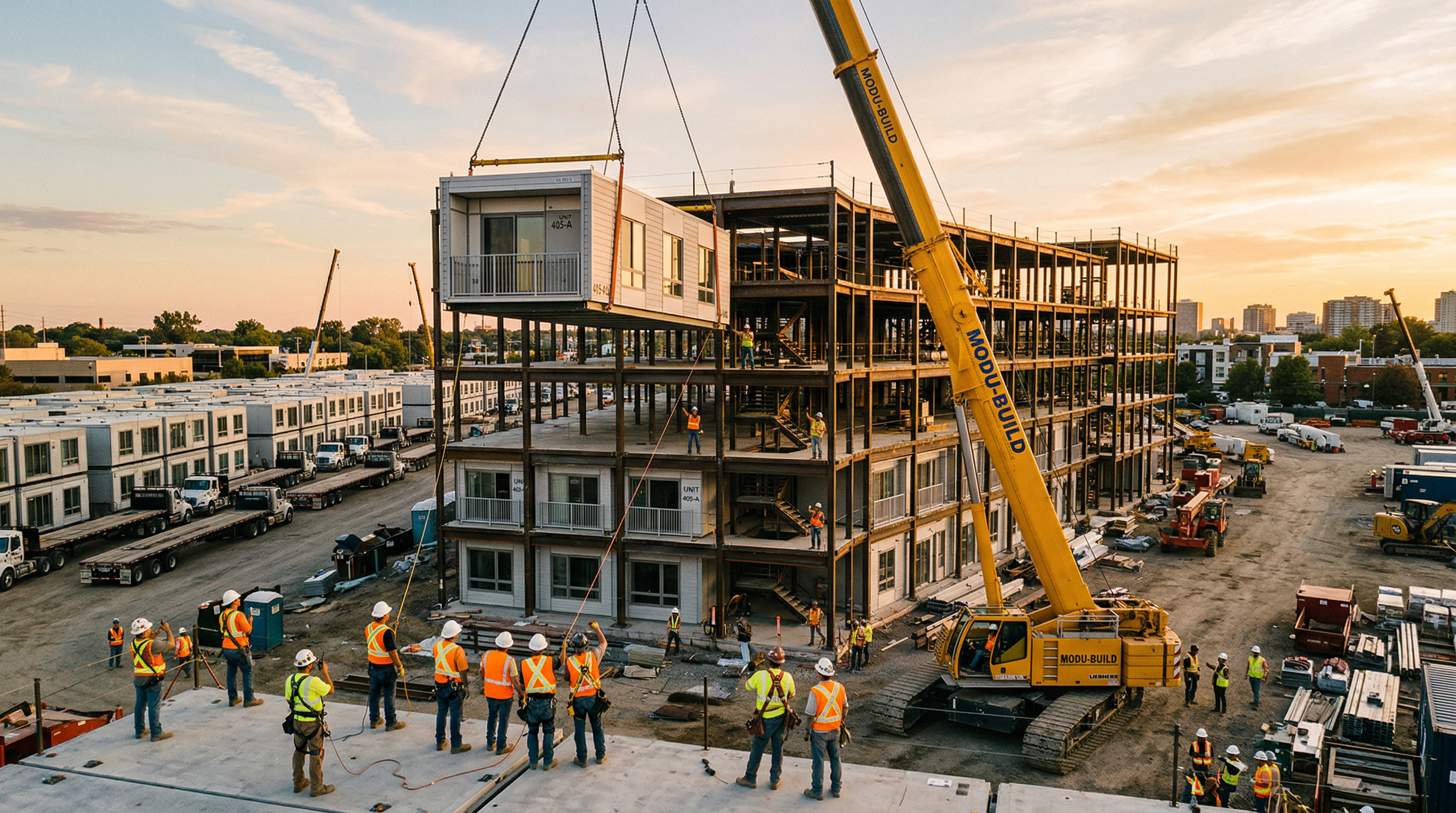
A fully assembled hotel room traveling down an interstate on a flatbed truck is no longer an unusual sight. What used to be a niche approach reserved for temporary structures has become one of the fastest-growing segments of the U.S. construction industry. The global modular construction market is projected to reach $117 billion in 2026, growing at an 8.3% clip, and the broader prefabricated construction market is on pace to hit $292 billion this year. The numbers tell a clear story: off-site construction has arrived, and it is rewriting the economics of how we build.
Why the Industry Is Shifting Off-Site
The forces driving modular and prefabricated construction adoption are the same pressures I hear about from clients every week: labor shortages, rising material costs, and project timelines that keep stretching longer. Traditional construction projects now experience delays 85-91% of the time, with median delays exceeding 200 days. Nearly half of delayed projects see costs balloon by more than 20%.
Modular methods directly address these pain points. According to a peer-reviewed analysis of large-scale projects, modular construction reduces costs by an average of 22% and shortens timelines by 35% compared to traditional methods. The cost per square foot for commercial modular projects runs around $125 versus $160 for conventional builds. For residential, the gap is even wider: $110 per square foot versus $145.
The timeline advantages are equally striking. A 193-unit affordable housing project documented by Harvard researchers cut its construction schedule from 24 months to 14 months by going modular, coming in 4% under budget in the process. McKinsey's research points to manpower reductions of up to 40% and timeline acceleration of up to 50% when modular techniques are applied at scale.
These are not marginal improvements. For a developer carrying a construction loan, shaving five months off a build translates into $3,000 to $8,000 in interest savings alone, before factoring in earlier revenue from occupancy.
Where the Growth Is Concentrated
The adoption curve is steepest in sectors where speed and cost predictability matter most. Affordable housing programs, student housing, hospitality, healthcare facilities, and data centers are leading the way. The U.S. prefabricated home manufacturing industry has been growing at a 6.5% compound annual rate since 2021, fueled by regulatory changes that are expanding design flexibility and financing accessibility.
Government backing is accelerating the trend. Programs like the Module Mission-Driven Developer initiative, launched in late 2025, provide modular training, technical resources, and pre-development support for developers building energy-efficient affordable housing that meets Department of Energy Zero Energy Ready standards. State and local governments across the country are actively promoting prefabricated solutions, including modular infill and accessory dwelling units, as a response to housing affordability challenges.
The sustainability angle is strengthening the business case further. Factory-controlled manufacturing reduces construction waste from the industry average of 25-30 kg per square meter down to 10-15 kg per square meter. Material utilization rates reach 85%, compared to roughly 60% for traditional construction. For developers navigating increasingly stringent energy efficiency and carbon regulations, prefabricated components produced in controlled environments offer superior insulation consistency and make it easier to meet evolving building codes.
The Insurance Gap Most Developers Overlook
Here is where my world intersects directly with this trend. Modular construction creates a fundamentally different risk profile than traditional building, and the insurance industry has not fully caught up. I have reviewed insurance programs for modular projects where coverage gaps were present in nearly every case. The problem usually comes down to one thing: the insurance was structured as if the project were either a standard manufacturing operation or a conventional construction job. It is neither.
A modular project involves three distinct phases of risk: factory fabrication, transit, and on-site assembly. Each phase carries its own exposures, and a standard builders risk or general liability policy is not designed to cover all three seamlessly.
Consider builders risk coverage. Traditional policies are designed around work performed at a job site, with values that increase incrementally as construction progresses. A modular project inverts that model. Significant value is created off-site in a factory, then concentrated in transit as completed modules move to the site. Standard builders risk policies may include property-in-transit coverage, but sublimits are often inadequate. If a flatbed carrying a $200,000 completed module is involved in an accident, a $25,000 transit sublimit creates a serious gap.
General liability presents its own complications. Prefabricated units and modules can be considered "products" under most states' product liability laws, regardless of their size or complexity. This means a modular manufacturer faces exposure not just under traditional construction liability theories but also under product liability claims for design defects, manufacturing defects, and failure to warn. The larger and more complex the prefabricated unit, the more latitude plaintiffs' attorneys have to allege defects. Assembly instructions for modular components must be comprehensive and precise, because any ambiguity opens the door to failure-to-warn claims.
Professional liability is another area of concern. Many modular contractors handle design in-house using CAD software rather than outsourcing to a third-party architect or engineer. Each design is typically bespoke. If a completed building fails to meet design parameters, the contractor faces significant professional liability exposure that their standard insurance program may not adequately cover.
Delay and business interruption risk also looks different. If a loss occurs at the manufacturing facility or a key supplier becomes insolvent, replacement units may take weeks or months, particularly when fabrication happens overseas. Delay in Start-Up coverage needs to account for these extended lead times, which are materially longer than ordering replacement materials for a traditional build.
Modular construction creates three distinct risk phases -- factory, transit, and assembly -- that most standard insurance programs are not designed to cover seamlessly. Working with a broker who understands these exposures before groundbreaking is critical.
The Bottom Line
Modular and prefabricated construction is not a future trend. It is a present reality reshaping how projects get built across the country. The economics are compelling: lower costs, faster timelines, less waste, and better quality control. But the insurance and risk management side of the equation requires deliberate attention.
If you are considering a modular or prefabricated approach for your next project, the time to involve your insurance advisor is during the planning phase, not after contracts are signed. A properly structured program should address off-site fabrication coverage, adequate transit limits, product liability considerations for the manufacturer, professional liability for in-house design work, and delay coverage that reflects realistic replacement timelines. Getting this right from the start protects your investment and ensures the cost savings that drew you to modular in the first place actually make it to the bottom line.
Planning a Modular or Prefab Project?
I can help you structure an insurance program that covers the unique risks of off-site construction from factory to final assembly.
Get in Touch