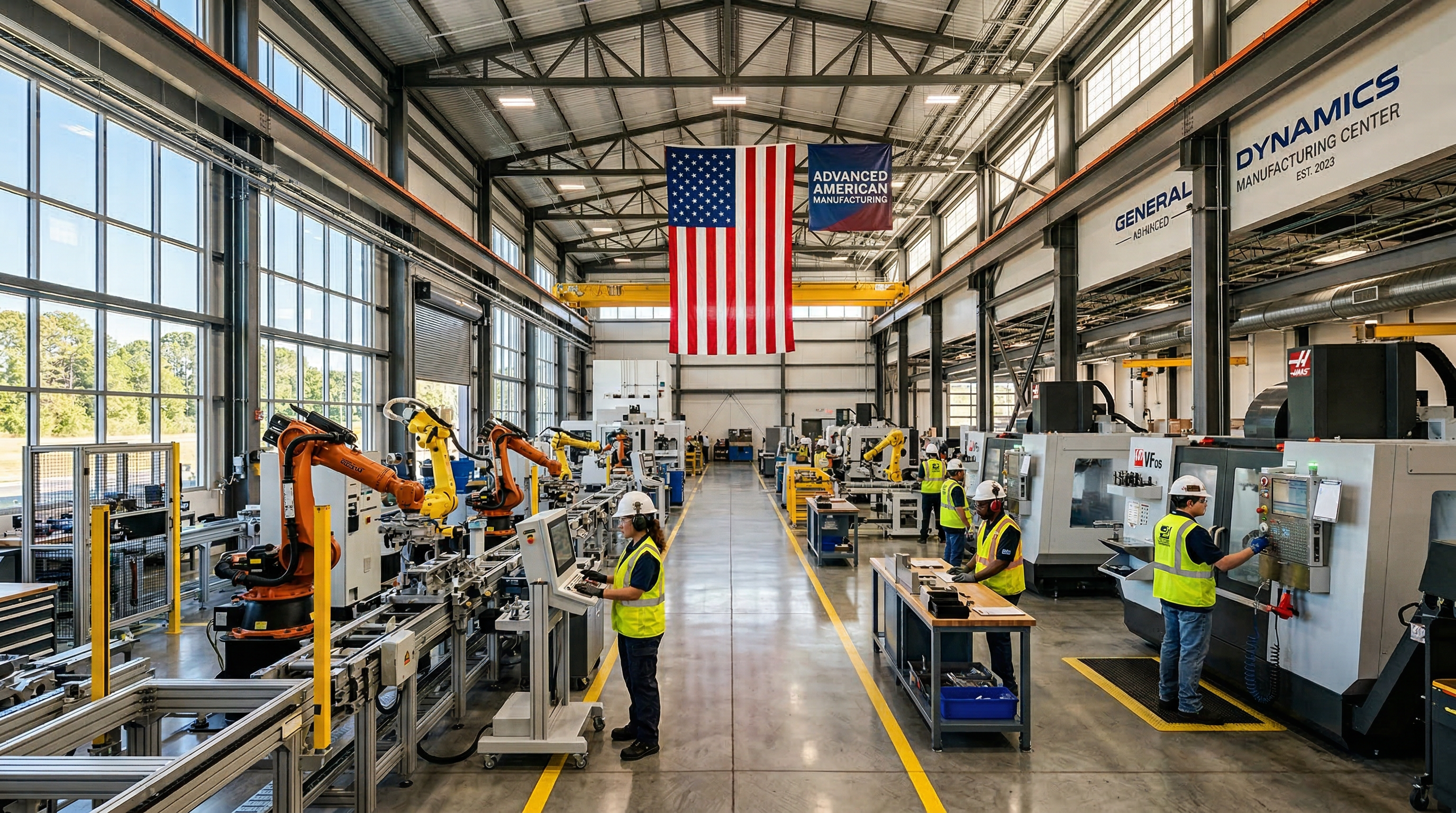
American manufacturing is experiencing something that would have seemed unlikely a decade ago: a genuine, large-scale return of production to domestic soil. Companies have committed more than $500 billion in private sector investment to revitalize U.S. manufacturing capacity, with semiconductor fabrication plants, pharmaceutical facilities, battery factories, and advanced materials operations breaking ground across the country. In my work at IMA Financial Group, I am seeing the downstream effects of this reshoring wave every week -- new facilities that need to be insured, construction projects with complex risk profiles, and manufacturers navigating operational exposures they have never managed domestically before.
The Scale of What Is Being Built
The numbers are staggering. As of early 2026, the CHIPS Program Office alone has issued awards to over 30 companies across more than 45 project locations, committing approximately $31 billion in direct federal funding and $5.5 billion in government loans. But the federal dollars are a fraction of the story -- the private capital expenditure associated with CHIPS-supported sites is approaching $400 billion in planned company investment.
The individual projects tell the story even more clearly. Micron is investing $200 billion across facilities in Idaho, New York, and Virginia, with its New York fab breaking ground in January. TSMC committed $100 billion to new fabs, advanced packaging facilities, and an R&D center. Samsung is building a $17 billion semiconductor plant in Taylor, Texas, expected to be operational this year. Eli Lilly is investing $27 billion in four pharmaceutical manufacturing facilities across Alabama, Texas, and Virginia. Texas Instruments is spending $11 billion on a new 300-millimeter fab in Utah. Rivian is ramping up construction on a $5 billion EV facility in Georgia that will produce 400,000 vehicles annually by 2028.
Cumulative manufacturing construction spending has outperformed its 2019 baseline by $433 billion over the past six years. The computer, electronic, and electrical equipment segment accounts for roughly 76 percent of that outperformance. The geographic concentration is equally notable -- four census divisions account for 88 percent of the national increase, with the Mountain and West South Central regions alone representing 47 percent of the growth, driven primarily by semiconductor megaprojects.
Since 2013, the number of manufacturing facilities in the U.S. has been steadily growing -- reversing a trend that saw 65,000 factories close between 2001 and 2013. The reshoring wave of 2024-2026 is accelerating that recovery at a scale not seen in a generation.
What Is Driving the Reshoring Decision
The calculus behind reshoring has shifted on multiple fronts simultaneously. The CHIPS Act and the Inflation Reduction Act created the incentive structure, but the underlying drivers go deeper than subsidies.
Supply chain security has become a board-level priority. The pandemic and subsequent disruptions exposed how vulnerable extended global supply chains are to geopolitical risk, shipping bottlenecks, and single-point-of-failure dependencies. Manufacturers are bringing production closer to end markets not just because the government is paying them to, but because their customers and investors are demanding it.
Tax policy is reinforcing the trend. The One Big Beautiful Bill Act increased the advanced manufacturing investment credit from 25 to 35 percent and restored immediate expensing for capital equipment purchases and R&D costs. Combined with state and local incentives -- many of which include property tax abatements, workforce training grants, and infrastructure commitments -- the total incentive package for a new domestic facility can be substantial.
Currency dynamics are also playing a role. The U.S. dollar has declined from its 2024 peak and is expected to continue a gradual slide, making domestic production more cost-competitive relative to imports. Tariff policy, while creating uncertainty, has also made the "import versus produce domestically" math more favorable for many categories of goods.
But the single biggest challenge remains workforce. Sixty-five percent of surveyed manufacturers identify attracting and retaining talent as their number one business challenge. It is also the top criterion for manufacturing site selection, ranking ahead of taxes, currency, regulations, and tariffs. The reshoring wave is creating demand for workers in regions that have not had significant manufacturing employment in decades, and the training infrastructure has not yet caught up.
The Risk Landscape for New and Reopened Facilities
This is where I spend a significant amount of my time with manufacturing clients, and it is where I see the most gaps between what companies plan for and what they actually need.
New manufacturing facilities -- especially advanced ones like semiconductor fabs, battery plants, and pharmaceutical production sites -- carry equipment values that dwarf traditional manufacturing operations. A single EUV lithography machine in a chip fab can cost more than $300 million. When you are insuring a facility with billions of dollars in specialized equipment, the property insurance program needs to be structured with precision. Standard manufacturing property forms may not adequately address the replacement cost and lead time for highly specialized machinery that has a 12 to 18 month delivery window.
- Business interruption coverage must account for the reality that these facilities cannot simply restart overnight. Semiconductor fabs, for example, require weeks or months to recalibrate after any disruption. Extended period of indemnity and contingent business interruption for supply chain dependencies are essential.
- Builders risk during the construction phase carries unique exposures because many of these projects involve first-of-their-kind construction in the U.S. -- cleanroom environments, specialized chemical handling systems, and equipment installation sequences that require careful coordination.
- Environmental liability is elevated for facilities handling chemicals used in chip fabrication, battery manufacturing, and pharmaceutical production. Many of these processes involve hazardous materials that require standalone pollution coverage and careful compliance with state and federal environmental regulations.
- Product liability takes on new dimensions when production is brought in-house for the first time. Manufacturers who previously sourced components internationally now own the full liability chain for those products. The transition from quality assurance of incoming goods to quality control of domestic production requires a corresponding adjustment in the insurance program.
- Cyber risk is increasingly intertwined with manufacturing operations. Modern facilities run on interconnected operational technology systems that, if compromised, can halt production entirely. The convergence of IT and OT networks in advanced manufacturing creates exposures that require dedicated cyber coverage.
The Bottom Line
The reshoring of American manufacturing is real, it is massive, and it is creating a generation of new facilities with risk profiles that do not fit into the insurance programs most manufacturers have carried historically. The companies that are building or reopening plants in 2026 are investing billions of dollars in assets that require sophisticated coverage structures -- from construction through commissioning to full operations. The insurance program should be designed alongside the facility, not bolted on after the ribbon-cutting.
If you are building, expanding, or reopening a manufacturing facility, the time to engage your insurance advisor is at the planning stage -- when decisions about site selection, construction methodology, and equipment procurement are still being made. Those decisions have direct implications for how your risk program should be structured.
Building or Expanding a Manufacturing Facility?
I work with manufacturers navigating the complex insurance requirements of new facility construction, equipment installation, and operational ramp-up. I can help you build a program that matches the scale of your investment.
Get in Touch