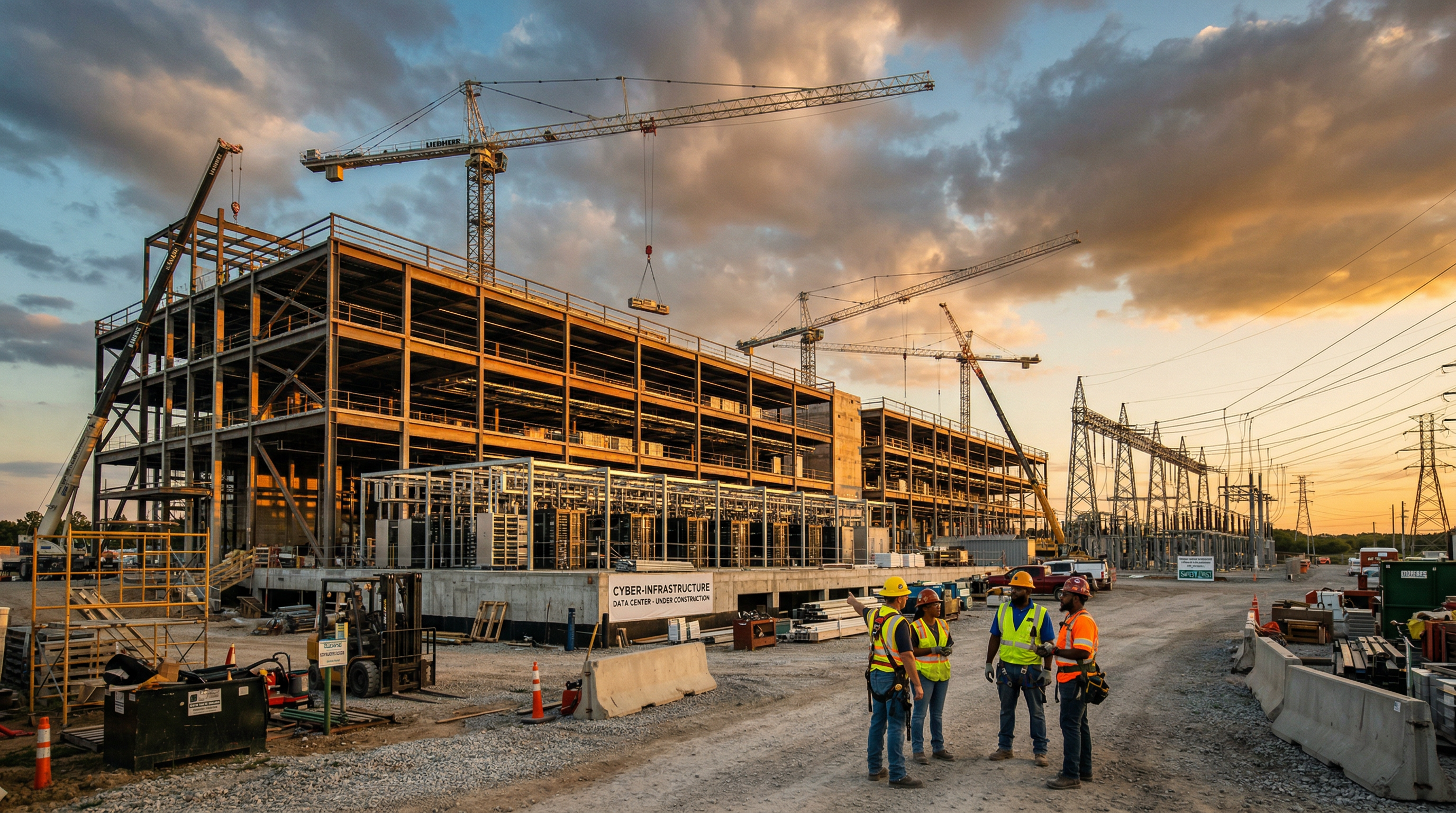
There is no sector in commercial construction moving faster right now than data centers. U.S. data center construction starts reached $77.7 billion in 2025 -- a 190% increase over the prior year -- and the pipeline for 2026 already exceeds that figure. The five major hyperscalers alone have committed nearly $970 billion to buildouts. But the story behind the numbers is more complicated than a simple boom, and the implications for developers, contractors, and their insurance programs are significant.
The Scale Is Staggering
The AI arms race has turned data center construction into the most bullish sector in the industry. According to ConstructConnect, average monthly construction starts jumped from roughly $500 million in mid-2021 to $6.5 billion by December 2025. The Associated General Contractors' 2026 Construction Outlook survey reflects this confidence: a net 57% of contractors expect data center spending to increase this year, making it the most optimistic sector in the entire survey -- far ahead of power construction at 34%.
The projects themselves are massive. The Stargate Project, announced in early 2025 by OpenAI, SoftBank, Oracle, and MGX, committed $500 billion over four years for AI infrastructure. Vantage Data Centers broke ground on a $15 billion, 672-acre complex in Wisconsin. Meta started its 30th data center. Amazon Web Services committed $100 billion to expand its AI capabilities. ConstructConnect is already tracking 76 projects valued at more than $88 billion slated to break ground in the first half of 2026 alone.
The workforce implications are equally dramatic. A December 2025 study from the American Edge Project counted 4,149 active U.S. data centers with 2,788 more announced or under construction -- expected to generate 4.7 million temporary construction jobs.
Power Is the New Bottleneck
For all the capital flowing into data centers, the biggest constraint is no longer chips or land -- it is power. Grid interconnection queues in critical markets now stretch five to seven years. In Q4 2025, developers added only 25 gigawatts of electricity capacity to their project pipeline, half of what was added the previous quarter, according to Wood Mackenzie.
Only about a third of the 241 gigawatts in the current pipeline are under active development, and many projects will never get built. Utilities simply do not have the grid capacity or generating capacity to accommodate this wave of demand. Gartner has projected that power shortages will operationally restrict 40% of AI data centers by 2027.
The primary constraint for data center growth has shifted from securing semiconductor chips to securing reliable power. Grid interconnection delays of 5-7 years in critical markets are now the dominant project risk.
This is reshaping how companies approach development. Some hyperscalers, notably Oracle with its Stargate campuses, are investing in behind-the-meter natural gas generation to bypass the grid entirely. Others are pursuing long-term deals not just for renewable energy credits but for firm, dispatchable power capacity. The result is a bifurcating market: developers with secured power access will continue building at pace, while those stuck in grid queues face delays, cancellations, or consolidation.
A Specialized Risk Profile Demands Specialized Coverage
Data center construction is not traditional commercial construction, and treating it as such from an insurance perspective is a mistake I see too often. These projects carry a unique combination of characteristics that create distinct risk exposures.
Speed-to-market pressure drives aggressive timelines. A hyperscale campus can involve tens of thousands of workers at peak, with massive equipment and material flows. The technical complexity -- from power distribution systems to GPU cooling infrastructure -- means that a single misstep or faulty workmanship can trigger costly delays or catastrophic losses. Phased completion adds another layer: data centers are typically built and commissioned in stages based on demand, creating ambiguity about when builders risk coverage ends and operational property coverage begins.
The insurance market has not fully caught up. Traditional builders risk, commercial general liability, and professional liability policies often contain coverage gaps for data center-specific exposures. Zurich North America recently launched Data Center Project Guard, a first-of-its-kind builders risk product designed specifically for this sector -- covering climate control system failure, losses at supplier locations, and up to 12 months of post-construction property coverage including business interruption. That kind of purpose-built coverage is increasingly necessary.
Key coverage considerations for data center projects include:
- Builders risk policies that account for phased commissioning and the high value of installed equipment, not just the building shell.
- Business interruption coverage calibrated to 24/7 operations where even brief outages cascade into significant revenue losses.
- Equipment breakdown coverage for the specialized mechanical and electrical systems that keep data centers running.
- Environmental liability coverage for on-site power generation, which is becoming standard for hyperscale campuses.
- Professional liability and errors and omissions coverage for the engineering and design consultants involved in these technically complex builds.
- Subcontractor default insurance structured to reflect the heightened technical competency these projects demand.
The Bottom Line
Data center construction is not just another hot sector -- it is fundamentally reshaping the U.S. construction landscape. McKinsey estimates $7 trillion in global data center capital expenditures by 2030, with more than 40% flowing through U.S. markets. For developers and contractors, the opportunity is enormous, but so are the risks. Power constraints, workforce shortages, aggressive timelines, and technically complex builds all create exposures that standard insurance programs were not designed to handle.
The contractors and developers who succeed in this space will be the ones who treat insurance as a strategic tool rather than an afterthought -- engaging with brokers early, securing purpose-built coverage, and mapping risks before breaking ground.
Building or Investing in Data Center Infrastructure?
I work with developers and contractors to structure insurance programs that match the unique risk profile of data center construction. If you have a project in the pipeline, let's talk before you break ground.
Get in Touch